Project Description
The Mekong River Basin was a major hub for drug trafficking in Southeast Asia. Although opium production had declined due to international crackdowns and alternative crop policies, the drug problem persisted with the rise of synthetic drugs, which were easier to manufacture. Along the river, 70 Border Liaison Offices (BLOs), staffed by police, soldiers, and border guards, addressed transnational crimes such as narcotics smuggling and human trafficking. However, their efforts were hindered by limited expertise, inadequate equipment, and weak coordination among BLOs.
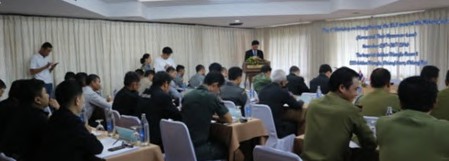
To strengthen regional cooperation against transnational crimes, particularly drug trafficking, the “Strengthening of Border Liaison Office (BLO) Around the Mekong River” project was implemented across five Mekong countries. It focused on human resource development through training, equipment support, and workshops at key border locations. These efforts improved BLO capacity, reduced crime rates, and bolstered Mekong-ROK collaboration.
Our Core Objectives
1
To enable Mekong countries to achieve balanced development.
2
To suppress transnational crimes in the Mekong region.
3
To improve job training for BLO staff.
4
To upgrade old equipment for better drug control.
5
To promote cooperation among BLOs.
Activities / Components
1
Pre-Project Workshop
Prepare for workshops.
Coordinate implementation strategies.
Objective: Ensure effective cross-border cooperation.
2
Northern Region Support
Enhance staff skills. Localized training.
Expert-led knowledge sharing.
Objective: Enhance staff capacity in border control.
3
Central Region Support
Enhance capabilities.
Lectures and equipment support.
Objective: Strengthen operational capabilities through training and equipment provision.
4
Invitational Training in Korea
Conduct on-site investigations. Objective: Facilitate hands-on learning through field investigations.
5
Southern Region Support
Hold training activities. Share knowledge.
Objective: Promote knowledge exchange through regional training activities.
Results Achieved
-
Improved BLO operational capabilities.
-
Fostered mutual trust.
-
Strengthened BLO capacity in 5 countries (Cambodia, Lao PDR, Myanmar, Thailand, Viet Nam).
-
Training, equipment, international cooperation
-
3 local training programs (northern, central, southern Mekong).
-
Promoted cross-border collaboration.
-
90 BLO officers trained (border control techniques).
-
UNODC expert support.
-
Equipment provided: motorcycles, radios, searchlights, speed boats.
-
Invitational training in Korea: BLO staff visited law enforcement agencies.
-
Insights into advanced investigative and interdiction strategies.
-
Reduction in transnational crimes (drug trafficking).
-
Supported regional economic development and public safety.
BLOs
- Northern: Kyaing Lath, Xiang Kok, Chiang Saen, Ton Phueng
- Central: Nongkhai, Vientiane
- Southern: Bavet, Moc Bai
Successful Factors/Strategies
- Regional Cooperation: Involved 5 Mekong countries and key organizations.
- Ensured shared ownership and commitment.
- Targeted Capacity Building: Local and invitational training; Tailored to regional needs; Enhanced practical skills; Knowledge Transfer.
- Exposure to Korean law enforcement practices. Introduced modern techniques.
- Fostered long-term learning.
- Strong Project Coordination: On-site management by a dedicated implementer; Ensured smooth execution.
Future Strategies and Plans
- More project outputs (e.g., pre-workshop).
- Strengthening of the BLO network.
- Develop a close network among Mekong River BLO officers.
- Conduct local workshop (3 times).
- Identify the need for an additional project to further strengthen BLOs.
- Address the rise in transnational crimes associated with economic growth.