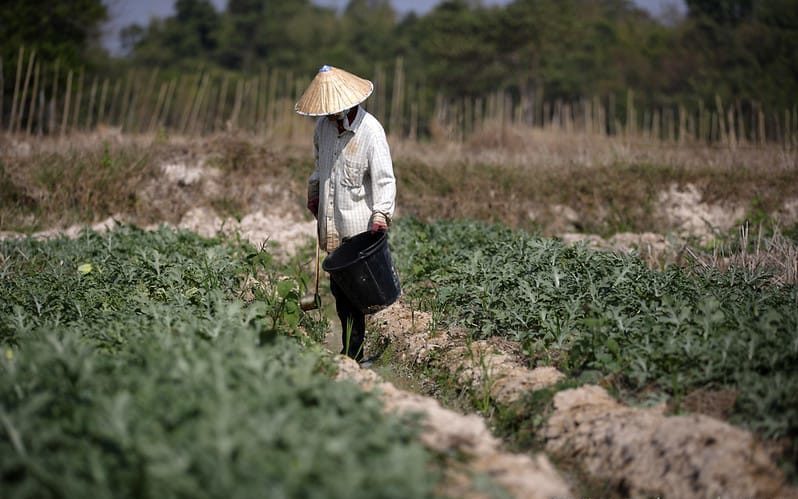
Lao PDR's economy was primarily agricultural, contributing significantly to its GDP, with a substantial land area devoted to farming, mainly for subsistence sticky rice production. Soil quality, water scarcity, and plant nutrient deficiencies posed major agricultural challenges, particularly in drought-prone zones, leading to low yields and reduced farmer income. This unsustainable agriculture in remote areas drove young farmers to seek work in cities or overseas. While some farmers attempted harvesting and composting, insufficient water storage techniques hindered soil moisture retention, which is crucial for dry-season cropping. The project aimed to address these issues through holistic demonstrations of proper soil, water, and nutrient management systems in three provinces (Savannakhet, Saravane, Champasack). These innovations emphasized adaptation and validation through farmer consultation, ensuring compatibility with their interests and practicalities. Ultimately, the project aimed to increase crop yield and farmer income, while reducing rural out-migration.
To create optimal soil, water, and nutrient management models for farms in drought-prone areas of Lao PDR.
To empower smallholder farmers to learn rainwater retention and soil improvement techniques for both wet and dry seasons.
To promote the efficient use of agricultural land among smallholder farmers.
To increase farmer income by facilitating market access.
To reduce labor migration from rural areas to cities.
Established land use, water, and crop nutrient management models, selected suitable villages and farmers, conducted baseline surveys, carried out land zoning and utilization planning, and provided technical and material support to farmers.
Transformed field technologies into manuals, guidelines, and policies, communicated and cooperated with relevant departments and experts, and provided feedback on project experiences to the policy level.
Promoted project achievements by organizing exchange activities among Mekong River countries, allowing representatives to visit the demonstration site.
Developed soil, water, and nutrient management courses suitable for arid areas of Lao PDR, drawing on Thailand's experience, to enhance the scientific basis of project implementation.
Trained local staff and conducted trainer training (TOT) to enhance their professional knowledge and teaching ability through theoretical study, discussion, and on-site practice.
Supported farmer capacity building by providing training and demonstrations covering land zoning management, crop planting techniques, and organic fertilizer production, and offered material support and market connection guidance.