Project Description
At the 36th ASEAN Ministerial Meeting, the vision for building a competitive, inclusive, resilient, and sustainable food, agriculture, and forestry sector integrated with the global economy within the ASEAN single market was confirmed. The Mekong River region, a major global rice producer, faced stagnant production efficiency, high costs, and significant impacts from climate change. These challenges have hindered agricultural development, poverty reduction, regional food security, and economic prosperity. Recognizing the importance of regional cooperation, Thailand, a leading global rice exporter, believed that increasing rice production would significantly boost the agricultural economy in the Mekong River region. By sharing its expertise in rice production, Thailand aimed to further the common goal of enhanced rice output among the Mekong River Cooperation countries.
Our Core Objectives
1
To develop a cooperation network on efficient rice production and rice production planning between the Mekong countries and the Republic of Korea (ROK).
2
To achieve sustainable and resilient agriculture in the Mekong region and improve rural livelihoods and poverty alleviation through the dissemination of project outputs.
3
To build capacity in the systematic use of geospatial technology and products to minimize the harmful side effects of development.
Activities / Components
1
Designed and delivered three structured training modules.
2
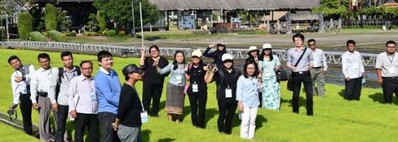
Conducted an on-site study visit to South Korea for hands-on learning.
3
Provided theoretical and practical training to enhance technical skills in rice production.
4
Promoted cost reduction strategies and quality improvement techniques.
5
Encouraged the adoption of green productivity practices.
6
Supported the establishment of an agricultural cooperation network between Mekong countries and South Korea for sustainable development and poverty reduction.
Results Achieved
-
The professional knowledge and practical abilities of 17 agricultural personnel from CLMVT countries were enhanced through systematic training, showing significant improvement in knowledge across Efficient Planting, Green Processing, and Remote Sensing Monitoring modules.
-
Awareness of green rice processing was cultivated, promoting energy-saving and environmental protection technologies; trainees mastered concepts of waste reuse, energy saving, and green productivity.
-
Initial application capacity of remote sensing and GIS in rice cultivation monitoring was established, with some countries (Thailand and Lao PDR) beginning to use remote sensing data for flood monitoring and planting area planning.
-
The regional cooperation network was initially established through collaborative group activities among trainees.
-
The response capabilities of participating countries in sustainable agriculture and food security were enhanced.
Successful Factors/Strategies
- Modular and practice-oriented training design divided the program into three core modules (planting, processing, and monitoring) and an on-site investigation. A hybrid model of lectures, practical operations, case analyses, and on-site visits significantly enhanced learning outcomes and participation.
- The combination of theory with on-site experience and practical application helped participants understand and master advanced technologies, proving particularly suitable for those without field experience.
- Cross-border cooperation and experience sharing were promoted through group learning and presentation of country reports, facilitating the exchange of experiences and comparison of challenges. The Korean experience introduced during the on-site investigation stimulated participants' interest in innovation and potential cooperation.
Future Strategies and Plans
- Address challenges related to varied participant backgrounds and knowledge levels, as well as the high technical thresholds that require extended training and ongoing reinforcement.
- Establish a long-term mechanism for agricultural remote sensing monitoring and develop more professional and technical talent in the field.
- Encourage trainees to disseminate the knowledge gained in their home countries through re-training sessions, lectures, and demonstration projects to expand the project's influence.
- Urge the governments of participating countries to incorporate project outcomes into their national agricultural development plans, allocate necessary financial resources, and ensure continuous follow- up on project implementation.