Project Description
Cassava is a vital economic crop in the Mekong region, contributing significantly to national economies. Thailand currently leads as the world’s largest exporter of cassava starch, followed by Cambodia and Viet Nam. Together, these countries account for approximately 90% of the global market share—owing to abundant cassava supply and advanced processing technologies. However, analysis reveals critical gaps across the value chain, including limited regional collaboration, outdated farming practices, insufficient access to improved cassava varieties, and a lack of investment in product-specific cultivation and innovation. In addition, there is limited awareness of the environmental and health concerns associated with cassava production.
To address these challenges, it is essential to enhance the productivity, sustainability, and competitiveness of the cassava value chain, particularly in CLMV countries. Key interventions include promoting the use of renewable energy, improving energy efficiency in cassava processing, and investing in zero-waste production practices. Capacity building through targeted training modules on modern cultivation techniques, value- added product development, and effective waste management will also be critical to strengthening the sector and ensuring its long-term resilience.
Our Core Objectives
1
To strengthen and sustain the development of the cassava industry in the CLMVT region through knowledge and technology transfer, as well as cooperation in research and industrial activities.
2
To enhance the skills and mobility of CLMVT participants by facilitating knowledge and experience exchange through training courses related to the cassava value chain.
Activities / Components
1
A1
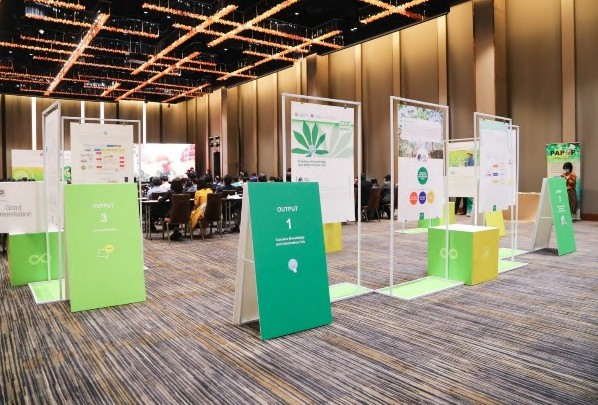
Cassava knowledge and technology hub established to facilitate dissemination and support technology transfer.
2
A2
Manuals and toolkits developed to support effective technology transfer
3
A3
Project lessons learned and cassava technologies widely disseminated.
4
B1
Training of cassava plantation technology conducted in Thailand for cassava producers and farmers from CLMVT.
5
B2
Training of cassava starch technology conducted in Thailand for plant managers, operators and technicians in cassava starch production process from CLMVT.
6
B3
Training of waste management and biogas technology conducted in Thailand for plant managers, operators and technicians in biogas production process from CLMVT.
Results Achieved
-
The “ASEAN Cassava Knowledge and Technology Center” was established as a platform for knowledge sharing and technology dissemination across the five CLMVT countries. The center continuously released training materials and industry updates through its website (sustainablecassava.org) and social media platforms (Facebook, LinkedIn, YouTube), creating a convenient space for information exchange and strengthening regional cooperation and professional networks.
-
Three major modules of both online and on-site
training courses were developed and delivered, covering sustainable cassava cultivation, starch processing, and waste management including biogas production. The training integrated "near-zero waste" and circular economy concepts, emphasizing optimization across the entire value chain. More than 100 practitioners from CLMVT countries—including farmers, engineers, and researchers—participated, significantly enhancing regional capacity and strengthening professional human resources.
-
Operation manuals, toolkits, and instructional videos covering the entire cassava value chain were compiled, providing standardized materials for future local adaptation and dissemination.
-
The project integrated circular economy principles, “near-zero waste” strategies, and green industrial development concepts across the cassava industry chain, shifting away from traditional high-consumption and high- pollution practices.
Successful Factors/ Strategies
- Regional Collaboration and Knowledge Sharing: The establishment of the ASEAN Cassava Knowledge and Technology Center fostered strong regional cooperation, enabling continuous exchange of information, technology, and best practices among CLMVT countries.
- Capacity Building and Sustainable Innovation: Comprehensive training programs and standardized materials empowered practitioners with modern, sustainable cultivation, processing, and waste management techniques, while integrating circular economy and near-zero waste concepts throughout the value chain.
- Integration of Environmental and Market-Oriented Approaches: The project promoted environmentally responsible production and increased awareness of health and sustainability standards, while enhancing market access and trade opportunities to strengthen the cassava industry’s competitiveness and long-term resilience.
Future Strategies and Plans
- Promote the localization and institutionalization of training by establishing a Training of Trainers (ToT) mechanism within the region. This will enable local governments and technical institutions to independently conduct training, moving beyond centralized and demonstration-based models with limited reach.
- Establish a long-term tracking mechanism—including on-site technical follow-up visits, online consultation platforms, and small-scale financial support for continued project implementation—to assess the practical application of the training received and provide ongoing technical guidance, thereby ensuring effective technology adoption.
Training Modules
- Training Module 1:- Cassava Root: Techniques for Sustainable Production
- Training Module 2:- Cassava Starch: Processing Technology
- Training Module 3:- Cassava Waste: Biogas Production and Waste Management